

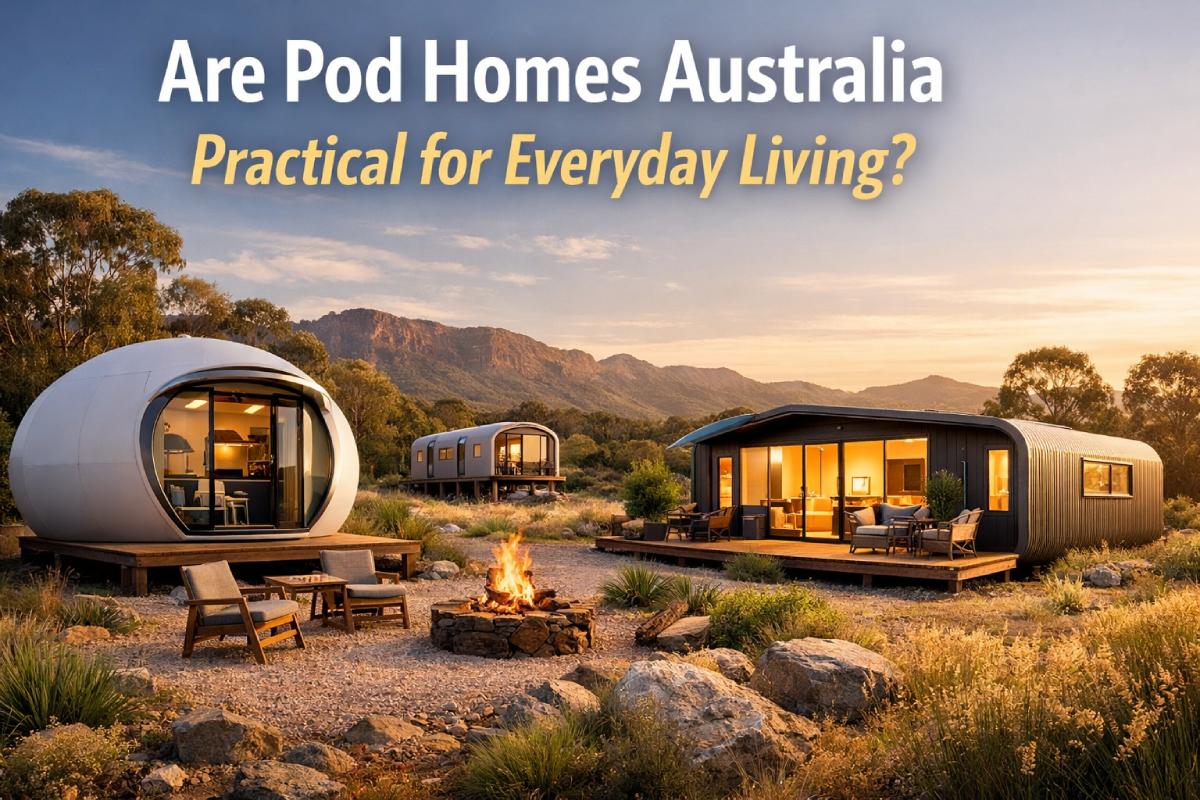
When people start looking into pod homes in Australia, curiosity usually comes first. The design feels modern. The footprint looks manageable. The idea of compact living seems efficient.
But once the visual appeal settles, a more practical question appears:
Could I actually live in one full-time?
Pod homes in Australia are often associated with short stays, backyard studios, or holiday retreats. Yet more Australians are now considering them as permanent housing solutions. The real question isn’t whether they look appealing.
It’s whether they function well in daily life.
What Living in a Pod Actually Feels Like
The biggest adjustment isn’t the size.
It’s the intention behind the layout.
In a pod home, every part of the space has a purpose. There are no oversized corridors, no formal rooms that sit empty, and no spare areas collecting unused furniture. Living, sleeping, cooking, and storage zones are organised carefully to avoid wasted square metres.
When examining how pod homes are structured nationally, the emphasis tends to be on efficiency and clarity of space rather than expansion. That broader housing positioning is reflected in how pod homes in Australia sit within the evolving compact housing sector.
For some people, that intentional structure feels calming.
For others, it requires a mindset shift.
The experience often depends more on lifestyle preference than square metres.
Space Perception Matters More Than Size
One common assumption is that smaller automatically means cramped.
That isn’t always true.
Ceiling height, window placement, and sightlines influence how spacious a home feels. A well-designed pod with natural light and clear visual flow can feel surprisingly open. In contrast, a poorly designed larger house can feel tight.
Storage design also changes the experience. Built-in cabinetry, concealed shelving, and multifunctional furniture prevent clutter from taking over limited floor space.
Pod homes tend to feel comfortable when layout, light, and storage are considered from the beginning.
Square metres tell part of the story.
Design finishes it.
How Construction Method Affects Durability
Another factor people rarely consider is construction consistency.
Many pod homes are built in factory-controlled environments. This can reduce weather-related delays and allow for tighter quality control during assembly.
Looking at howprefabricated pod homes are manufactured provides insight into how off-site construction can influence structural precision. Building indoors allows materials to be assembled under controlled conditions rather than exposed to varying weather during construction.
That doesn’t automatically make one method superior.
But it does change how consistency and efficiency are managed.
Long-term comfort isn’t only about layout.
It’s also about how well the structure performs over time.
Daily Living Looks Slightly Different
Living in pod homes in Australia often changes routines in subtle ways.
Cleaning becomes quicker. Smaller spaces take less time to maintain. Heating and cooling systems respond faster because there’s less volume to regulate.
Storage habits also evolve. With limited room for excess, decisions about belongings become more deliberate. This doesn’t mean extreme minimalism, but it does mean being thoughtful.
Some people find this liberating.
Others feel restricted by reduced flexibility.
The difference often comes down to personality and habit.
Climate Performance Across Australia
Australia’s climate diversity makes building performance important.
A pod home in tropical Queensland must manage airflow and humidity. One in Victoria may prioritise insulation and heat retention. In arid inland regions, temperature swings require careful material selection.
Because pod homes in Australia are compact, temperature changes can happen quickly inside the structure. High-quality insulation, effective glazing, and proper ventilation help stabilise indoor comfort.
Smaller homes can be energy efficient.
But only when designed appropriately for the region.
Climate suitability should never be an afterthought.
Planning and Compliance Considerations
Pod homes may be compact, but they still sit within Australia’s planning and building framework.
Approval requirements vary depending on location, zoning, and intended use. Backyard installations, rural dwellings, and primary residences may follow different approval pathways.
Some areas may allow streamlined processes if criteria are met. Others may require detailed applications and documentation.
The size of the dwelling does not eliminate compliance.
It simply changes the scale.
Understanding local council rules is part of evaluating pod homes in Australia realistically.
Who Pod Homes Suit Best
Pod homes tend to suit specific lifestyles.
They work well for individuals or couples who prefer low-maintenance living. They also make sense for rural landowners seeking compact dwellings without undertaking large-scale construction.
Backyard secondary dwellings can also align with pod-style design, provided local regulations allow it.
They may not suit larger families who require multiple bedrooms or those who host frequent gatherings requiring expansive entertaining areas.
It’s not about whether pod homes are “better.”
It’s about alignment.
Common Misconceptions About Pod Living
There are recurring misunderstandings around pod homes in Australia.
One is that they are temporary. In reality, once installed and approved properly, they function as permanent dwellings.
Another is that smaller homes compromise structural quality. That depends entirely on engineering and materials, not footprint.
A third is that they are only appropriate for holiday accommodation. While often used in tourism contexts, many pod homes serve as full-time residences.
The misconception usually stems from appearance.
The practicality depends on design and regulation.
Long-Term Livability
Can pod homes function as permanent homes?
Yes, but with realistic expectations.
Long-term livability depends on three main factors:
First, build quality. Proper insulation, solid framing, and durable finishes matter more in smaller spaces.
Second, layout efficiency. Clear separation between sleeping, living, and service zones prevents the space from feeling chaotic.
Third, personal lifestyle. People who value structure and organisation often adapt well. Those who rely on extra storage or multiple spare rooms may feel constrained.
The physical structure remains consistent.
Comfort depends on how you use it.
Are Pod Homes in Australia Practical?
For many Australians, pod homes represent a middle ground between full-scale houses and ultra-minimal tiny homes.
They can offer controlled construction, efficient layouts, and reduced on-site disruption. They can suit rural blocks, backyard placements, or compact primary residences.
But they still require planning compliance, site preparation, and climate consideration.
When those realities are understood, pod homes become easier to evaluate clearly.
Not as a trend.
Not as a novelty.
But as a compact housing option that either fits your lifestyle, or doesn’t.
And that clarity is what matters most when deciding.